Interpolation grids
A grid divides the irreducible Brillouin zone into cells whose corners, the grid's vertices, are where your model is evaluated. To interpolate at any other point, brille finds the cell that holds it and weights the values at that cell's corners by where the point lies within it. This page explains the ways such a grid can be built, and the three that brille provides.
Cells: parallelepipeds and simplices
There are many ways to divide a space, but the two simplest building blocks are the parallelepiped (a rectangle in two dimensions) and the simplex (a triangle in two dimensions, a tetrahedron in three). A simplex in \(N\) dimensions has \(N+1\) corners, a parallelepiped \(2^N\).
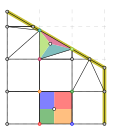
Parallelepipeds make a regular grid:
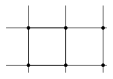
while simplices can be regular or, as here, irregular:
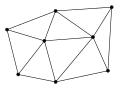
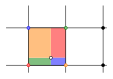
Within a parallelepiped, a point's value is the average of the corner values weighted by the areas of the opposite sub-rectangles (bilinear interpolation, trilinear in three dimensions):
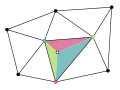
Within a simplex, the weights are the point's barycentric coordinates, the areas (volumes) of the sub-simplices opposite each corner, and the interpolation is linear:
Why not a regular grid
A regular grid has one great advantage: the cell holding any point can be calculated directly, so finding it takes constant time. But it fits a Brillouin zone only when the zone is itself a rectangular box, which is the case only for the irreducible zones of primitive cubic, tetragonal and orthorhombic lattices. Anywhere else the grid either misses part of the zone or reaches outside it, and the interpolation shows artefacts near the zone boundary. brille therefore has no plain regular grid.
A simplex mesh can fill any polyhedron exactly, but finding which simplex holds a point is not a simple calculation, so an unstructured mesh needs extra information to make that fast. brille's three grids differ in how they get the best of both.
The structured mesh: BZMeshQ
BZMeshQdc and its siblings are a regular grid
made to fit. The grid is the reciprocal lattice divided \(n\) times along each
of its primitive vectors, with \(n\) chosen from max_size, the largest
tetrahedron volume you ask for. Each grid cell is split into tetrahedra (six,
for most lattices), and the grid is then clipped exactly to the irreducible
zone. Clipping cuts the cells that the zone boundary crosses into smaller
pieces, which are also split into tetrahedra. The geometry is done in exact
arithmetic, so the result fills the zone exactly, whatever the lattice.
Because the mesh is built from the lattice, it has the lattice's symmetry: the triangles on a zone face match those on the face that symmetry pairs it with. So interpolation is continuous across the zone boundary, including when a point is moved into the irreducible zone from elsewhere.
Finding the tetrahedron that holds a point uses a grid of buckets over the zone, each listing the few tetrahedra that overlap it, so it takes constant time, as for a regular grid.
The mesh can also be refined where your model needs more points, by splitting the longest edges of chosen tetrahedra. Equivalent edges on the zone boundary are split together, so the mesh keeps matching itself, and a resolution limit stops refinement from making detail finer than an instrument can resolve. Building and refining a mesh shows how.
The hybrid trellis: BZTrellisQ
BZTrellisQdc and its siblings combine a
regular grid of cubic nodes with triangulation. Nodes inside the zone stay
whole, and their values are interpolated trilinearly. Nodes the zone boundary
crosses are cut to the zone and divided into tetrahedra, with the TetGen
library, and interpolated linearly. Finding the node that holds a point is
direct, and within a cut node only its own tetrahedra need searching.
The trellis's node_volume_fraction is the volume of one cubic node in Å⁻³,
despite its name. Its boundary tetrahedra do not match across equivalent zone
faces, so interpolated values can jump there. Mixing trilinear and linear
interpolation also means the interpolant is smooth in different ways inside and
near the boundary.
The nested mesh: BZNestQ
BZNestQdc and its siblings hold several TetGen
triangulations of the zone, each finer than the last, with the overlaps between
successive layers recorded. A point is located in the coarsest layer, then in
the tetrahedra of the next layer that overlap the one found, and so on down to
the finest layer.
If the \(i^\text{th}\) layer's tetrahedra each overlap \(\left<m\right>_i\) of the next layer's on average, locating a point takes about
in-tetrahedron tests, while the finest layer holds
tetrahedra. In practice the search is far slower than the other two grids' and the nested mesh is kept only for compatibility.
Real and complex data
The grids hold eigenvalue-like values and eigenvector-like vectors at each
vertex, and either may be complex. So each grid comes in three types: the
suffix dd holds real values and vectors, dc real values and complex
vectors (the usual case for phonons), and cc complex values and vectors.
Choosing a grid
Use the structured mesh unless you have a reason not to. Switch from BZTrellisQ to BZMeshQ compares it with the trellis, and shows how to measure the two for your own system.